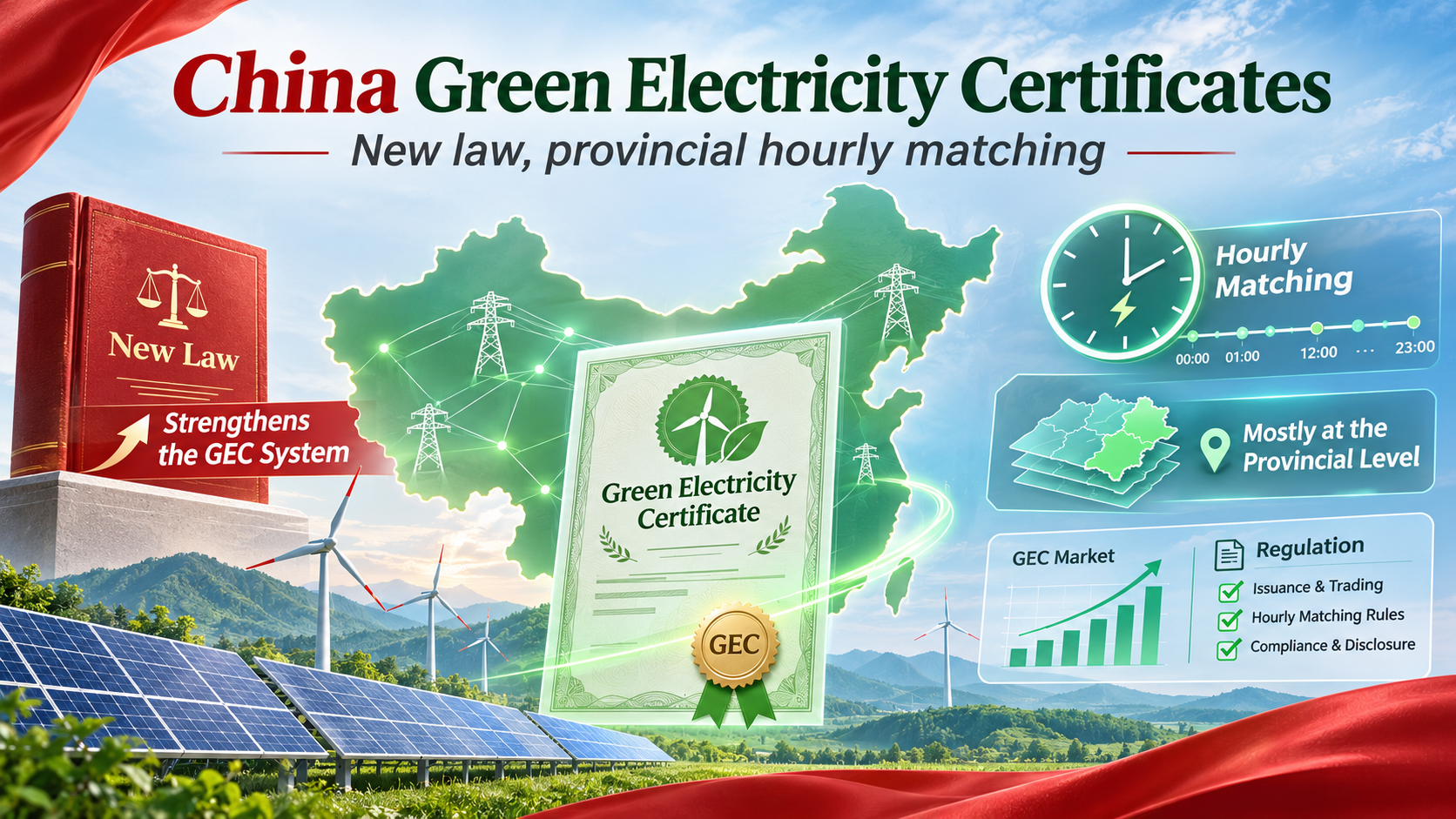
Between September and November 2026, China’s green electricity certificate (GEC) market moved beyond volume growth towards a stronger legislative foundation. The key milestone is a draft amendment to the Renewable Energy Law, submitted for its first reading on 2 November. Hourly matching, however, remains a provincial and project-level experiment rather than a nationwide granular-certificate system.
At a glance
- The draft Renewable Energy Law would formalise GECs, connect them with carbon accounting and product-footprint systems, and introduce proposed penalties of five to ten times the certificate cost of unmet renewable-consumption obligations. These are proposals, not enacted penalties.
- The National Energy Administration (NEA) acknowledges hourly green-power trading pilots but warns that national expansion could significantly raise GEC issuance and trading costs. China’s national GEC system still issues certificates in monthly batches.
- The NEA reported 2.65 billion GECs issued and 598 million traded in January–September 2026. A GEC alone does not automatically establish a verified actual electricity-emission factor for EU CBAM purposes.
Legislation and cross-border market developments
On 2 November, a draft revision comprising 10 chapters and 76 articles went to the National People’s Congress Standing Committee for first reading. It explicitly proposes a renewable GEC system and stronger links between electricity attributes, carbon accounting and market rules. Proposed non-compliance fines would be calculated against the previous month’s average certificate price. Legislative scrutiny may change these provisions.
On 14 October, HKEX announced that 15 corporate entities had traded approximately 100,000 Chinese GECs through its Core Climate cross-boundary pilot with the Guangzhou Power Exchange Centre. NEA officials later confirmed the transaction was facilitated at the end of September. This is a useful international-market connection, but not evidence of global equivalence between all certificate standards.
Central policy guidance published in October also called for improvements to China’s unified national certificate market.
What the NEA has said about hourly trading
In reply 国能提新能〔2026〕119号, dated 26 August and published on 29 September, the NEA described State Grid’s hourly green electricity trading pilot in Jiangxi. It warned that a broad roll-out could substantially increase the cost of issuing and trading certificates, and said preliminary research would come first.
In reply 国能建新能〔2026〕222号, dated 11 September, the agency said it was preparing a green-electricity consumption certification mechanism with the market regulator. It also noted that China’s national emissions-trading system does not currently regulate indirect emissions associated with electricity consumption.
The 2024 notice 国能综通新能〔2024〕124号 allowed certain deep-offshore wind and solar-thermal projects to choose between GECs and CCER credits, preventing double counting. Its specified term ended on 1 October 2026; no replacement document was identified in the sources reviewed by 16 November.
Granular certificates: provincial pilots, not national issuance
Ningxia reported its first intra-provincial hourly settlement on 2 November: 39 GWh of green electricity traded by Qingtongxia Aluminium with a photovoltaic supplier. Xinjiang separately reported a 24-period pilot involving 106 MWh and coordination with the national GEC system; reporting differs on the exact execution date.
An EnergyTag case study published on 9 October documented AsiaREC and Granular Energy matching electricity from a 300 MW offshore wind farm with consumption at TonyTech’s Huzhou site. The case demonstrates hourly attribution layered over existing Chinese GECs, not the creation of a new official nationwide hourly GEC product.
International accounting rules remain in flux. The GHG Protocol’s Scope 2 revision process has examined hourly matching and deliverability requirements, with implementation details and transition arrangements still subject to consultation. Such proposals should not be treated as binding requirements today.
Market volume and price signals
January–September 2026: the NEA issued 2.65 billion GECs (+23.61% year on year) and recorded 598 million trades (+13.07%). Of the traded volume, 355 million were separately traded and 244 million were associated with green electricity transactions; the difference reflects rounding. The GEC price index ranged from 181.0 to 245.3 points.
September alone: issuance reached 326 million (−8.01% month on month), with 60.45% tradable. Trading totalled 58.43 million (−10.23% year on year), including 39.45 million unbundled certificates. Average certificate prices were CNY 0.56 for 2024-generation GECs, CNY 1.60 for 2025 and CNY 6.16 for 2026.
Our calculation puts traded volume at 22.6% of certificates issued during January–September. This is a ratio of period flows, not a statement that only 22.6% of individual certificates can ever trade. Because one Chinese GEC represents 1 MWh, even the September average for 2026-generation certificates was below US$1/MWh at typical contemporaneous exchange rates. Vintage-specific eligibility and consumption-year matching contribute to the spread.
Implications for Europe and the Middle East
Commission Implementing Regulation (EU) 2025/2547 sets detailed evidentiary conditions for using actual emissions in CBAM calculations. Requirements depend on the specific electricity or goods provision; evidence can include qualifying direct connections or PPAs, hourly metering, traceability and verification. Possession of a Chinese GEC by itself is insufficient to satisfy all applicable conditions.
For EU-bound industrial supply chains, especially aluminium and fertiliser producers, firms should retain facility-specific contracts, meter data and certificate allocation records rather than assuming a province-wide trading pilot confers CBAM acceptance. For MENA countries, China offers a policy design worth examining: a single national certificate foundation, emerging compliance obligations and more granular voluntary or provincial data layers.
What to watch next
Track the draft law’s next reading, the green-consumption certification rules, any successor to notice 124, October GEC data and the scalability of provincial hourly trading. A national official hourly GEC issuance system should not be assumed imminent.
Sources and methodological notes
Xinhua — draft Renewable Energy Law, 2 November 2026
NEA — market briefing, 30 October 2026
NEA — September GEC statistics, 29 October 2026
NEA — response 119 on hourly pilot
NEA — response 222 on green-consumption certification
HKEX — cross-border GEC pilot, 14 October 2026
EnergyTag — China hourly matching case study
EU — Commission Implementing Regulation 2025/2547
Data cut-off: 16 November 2026. Xinjiang pilot timing differs between secondary reports; a missing successor notice is a negative search finding, not proof that no such document exists. Penalty provisions remain proposals. The 22.6% calculation is our own.